Posts

Showing posts with the label Technology

5 Technologies That Changed/Or Will Change The World

Image
1. Fibre Optics Fibre optic technology was first demonstrated in the 1840’s by Colladon and Babinet. Fibre optic tubes refract light within glass tubes with little loss of light over the length of the tube. In 1880 Alexander Graham Bell developed the technology to transmit voice signals over an optical beam. Bundled together, fibre optic cables are immune to electrical interference making them good for use in computer networking. Fibre optic transmissions are also much harder to snoop and are therefore considered more secure. 2. Graphene Graphene will completely revolutionise technology. Created at the University of Manchester, UK, graphene is a layer of graphite one atom thick. It is very strong, an excellent conductor of heat and electricity and is predicted to transform mobile devices. Imagine a flexible cellphone or tablet. 3. Cellphone Technology The technology to enable cellphones to communicate from a base station was proposed in 1947, h...

Why the U.S. Government Brought Nazi Scientists to America After World War II

Image
The atomic bombs dropped on Hiroshima and Nagasaki may have put an end to World War II, but they weren’t the only destructive weaponry developed during the war. From nerve and disease agents to the feared and coveted V-1 and V-2 rockets, Nazi scientists worked on an impressive arsenal. As the war came to a close in 1945, both American and Russian officials began scheming to get that technology for themselves. So it came to pass that 71 years ago today, 88 Nazi scientists arrived in the United States and were promptly put to work for Uncle Sam. In the days and weeks after Germany’s surrender, American troops combed the European countryside in search of hidden caches of weaponry to collect. They came across facets of the Nazi war machine that the top brass were shocked to see, writer Annie Jacobsen told NPR’s All Things Considered in 2014. Jacobson wrote about both the mission and the scientists in her book, Operation Paperclip: The Secret Intelligence Program That Brought Nazi Scie...

NASA’s new telescope will investigate the evolution of the universe

Image
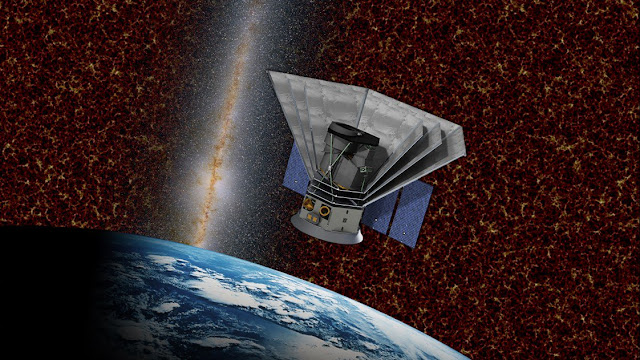
The telescope is projected to launch in 2023. A bit of a mouthful: This week, NASA announced it will create the Spectro-Photometer for the History of the Universe, Epoch of Reionization and Ices Explorer: SPHEREx for short. It’ll look at how our universe has changed, and how common the ingredients of life are in the Milky Way. What it will do: It will collect data on more than 300 million galaxies and 100 million Milky Way-based stars using optical and near-infrared light. SPHEREx will search for water and organic molecules in stellar nurseries (areas where stars are born). Every six months, the telescope will take a step back and look at the entire sky, creating a detailed sky map that will be used to identify targets for future missions like the James Webb Space Telescope. Why it matters: “It will deliver an unprecedented galactic map containing ‘fingerprints’ from the first moments in the universe’s history,” says Thomas Zurbuchen, associate administrator for NA...

The Plague Inspired Leonardo da Vinci's Ideal City

Image
Leonardo da Vinci survived a series of bubonic plagues that struck Milan between 1484 and 1485. These outbreaks, which killed some 50,000 people—a full third of the city’s population, inspired the Renaissance polymath to design concepts for a future city that he illuminated through a series of drawings and notations completed between 1487 and 1490 (that today can be found in Paris Manuscript B). At the heart of these concepts is da Vinci’s perspective on shifting the cityscapes of medieval cities like Milan—which were narrow, hard to navigate, dirty, crowded, and entirely conducive to the spread of disease—toward a more modern layout emphasizing aesthetics, cleanliness, and efficiency. To achieve this, da Vinci envisioned two signature features of a future city: a network of canals that would support both commerce and sanitation, and the vertical division of the city itself into as many as three different tiers, each for a different purpose. This vision was radical, and essen...

Lab Mice & Their Gut Bacteria

Image
Because of my ignorance of knowledge when it comes to lab mice and most biological and cellular science studies, this article comes from the UNL Newsroom website  back in November of 2018. Beating their brethren to the gut can help bacteria make a lasting impression, says new research from the University of Nebraska-Lincoln. The study suggests that the order in which bacterial species stake out unclaimed territory in the gut can shape an intestinal ecosystem for a lifetime, potentially shifting the odds of certain health outcomes in the process. Though timing wasn’t everything, multiple experiments showed that species given early access to the intestinal tracts of germ-free mice — before the prime real estate had been seized by others — generally took advantage. Over several months, the biodiversity of those burgeoning gut ecosystems often came to be dominated by, or at least resemble, the species that got there first. “These early colonizers, even when they didn’t persi...

DNA Nanorobots Successfully Attack & Kill Off Cancerous Tumors

Image
Science fiction no more — in an article in Nature Biotechnology , scientists were able to show tiny autonomous bots have the potential to function as intelligent delivery vehicles to cure cancer in mice. These DNA nanorobots do so by seeking out and injecting cancerous tumors with drugs that can cut off their blood supply, shriveling them up and killing them. “Using tumor-bearing mouse models, we demonstrate that intravenously injected DNA nanorobots deliver thrombin specifically to tumor-associated blood vessels and induce intravascular thrombosis, resulting in tumor necrosis and inhibition of tumor growth,” the paper explains. DNA nanorobots are a somewhat new concept for drug delivery. They work by getting programmed DNA to fold into itself like origami and then deploying it like a tiny machine, ready for action. The scientists behind this study tested the delivery bots by injecting them into mice with human breast cancer tumors. Within 48 hours, the bots h...

CRISPR-Cas: Editing Life

Image
The plan for all living things is written in the genes. The central dogma of biology states that the flow of genetic information in a cell goes from DNA to RNA to protein. The order of the four nucleotides that make the business end of a DNA molecule codes for a gene and that sequential order of the DNA code determines the protein to be made. The proteins, in turn, provide a specific function to the cell and, subsequently, to the whole organism. Life on this planet depends on the reliability of the information stored in the DNA. As we strive to learn more about the way life operates, manipulating genes is a necessity for the molecular biologist. Cloning genes, mutating genes, transferring genes are staples of the molecular biologist’s toolbox that we use to manipulate and study genes. New Molecular Tools There have been huge strides in molecular technology since the discovery of DNA as the chemical of inheritance in 1943 and the determination of its structure in 1953...

What You Need To Know About Trump's "AI Initiative"

Image
President Trump issued an executive order yesterday announcing what the White House calls an “American AI Initiative.” The order encourages research in the field of artificial intelligence in the United States. The announcement is based on principles that touch on issues like AI and jobs, and the relationship between American artificial research and the international community. The first principle lays out the main idea: the U.S. should “drive technological breakthroughs in AI across the Federal Government, industry, and academia in order to promote scientific discovery, economic competitiveness, and national security.” In short, the executive order says to the federal government, academia, and private sector: Do more artificial intelligence. The memo does not provide any new money for the initiative, although it does call for the White House Office of Management and Budget and the relevant agencies to prioritize funding artificial intelligence. Why Now? “A...

Marie Curie: Mother of Radiation

Image
Marie Curie (1867 – 1934) was a Polish scientist who won a Nobel prize in both Chemistry and Physics.   She made ground-breaking work in the field of Radioactivity, enabling radioactive isotypes to be isolated for the first time. During the First World War, Curie developed the practical use of X-Rays; she also discovered two new elements, polonium and radium. Her pioneering scientific work was made more remarkable because of the discrimination which existed against women in science at the time. She was the first female professor at the University of Paris and broke down many barriers for women in science. “Humanity needs practical men, who get the most out of their work, and, without forgetting the general good, safeguard their own interests. But humanity also needs dreamers, for whom the disinterested development of an enterprise is so captivating that it becomes impossible for them to devote their care to their own material profit.”  – Marie Curie  Short...

Why Bother With Science Fiction In Today's Technological World?

Image
What roles can Sci-Fi and Fantasy play in a world becoming more fantastical all the time? In a world that’s becoming more fantastical and science fictional by the day, it’s sometimes tempting to ask, what’s the point of science fiction or fantasy? After all, these days we have in our pockets and in our homes, devices that outstrip the projections of yesteryear science fiction—heck, many of us practically own magic mirrors, and oracles we can ask about the weather. But lots of us persist in writing and reading science fiction and fantasy. Why? The easy, and in my opinion mostly wrong, answer, is that science fiction and fantasy both expand our imagination, and plant the seeds of great advances. Science fiction primes us to go to the moon, or to Mars. Science fiction builds in its readers and viewers a desire for pocket communicators, for slabs of glass that hold all the books ever printed; fantasy inculcates a desire for devices that just work, for a home that responds to o...

The Rise & Fall of Nikola Tesla

Image
By the end of his brilliant and tortured life, the Serbian physicist, engineer and inventor Nikola Tesla was penniless and living in a small New York City hotel room. He spent days in a park surrounded by the creatures that mattered most to him—pigeons—and his sleepless nights working over mathematical equations and scientific problems in his head. That habit would confound scientists and scholars for decades after he died, in 1943. His inventions were designed and perfected in his imagination. Tesla believed his mind to be without equal, and he wasn’t above chiding his contemporaries, such as Thomas Edison, who once hired him. “If Edison had a needle to find in a haystack,” Tesla once wrote, “he would proceed at once with the diligence of the bee to examine straw after straw until he found the object of his search. I was a sorry witness of such doing that a little theory and calculation would have saved him ninety percent of his labor.” But what his contemporaries may ha...

How New Technologies Are Changing Language Learning

Image
AI, AR and VR are increasingly hot topics in the language learning space — with new tools and technologies being touted as silver bullets that will fundamentally change the way we learn. Numerous on-demand apps and free tools have made language learning accessible to everyone: Duolingo is a prime example, busuu’s Alexa bot is making it easy to practice hands-free while performing other household activities, and Google’s new wireless headphones offer real-time translation from Google Translate. And Mondly VR is leading the charge in the VR space with its foreign-language teaching app, which places people into situations where they’d need to use the language, like a cab ride or checking into a hotel. There's no doubt that technologies like this will have a massive impact on the way we learn, the way we live and the way we work. Some believe they’ll even eradicate the need to learn it at all — like Joshua Cooper Ramo, author of The Seventh Sense, who makes a case that mo...

Is Amazon Alexa Spying On You?

Image
Once the stuff of science fiction, voice-activated virtual assistants like the Amazon Echo, Google Home and Apple HomePod now reside in millions of American homes, tweaking thermostats, streaming music and scheduling appointments. While some see these devices as helping hands, others view them as Trojan horses in the age of digital surveillance. "It is outrageous that the Amazon Echo is recording every conversation in a person’s home and transmitting it to the cloud," Rep. Ro Khanna, D-Calif., tweeted May 26. "This is exactly why we need an internet bill of rights! Didn’t we fight a revolution to prevent exactly this kind of surveillance?" Is Khanna correct about the scope of smart speakers’ electronic eavesdropping? We decided to take a closer look. Does Amazon ‘record every conversation’? Amazon’s voice-controlled Alexa products are considered "always-on" devices — but that doesn’t mean they record customers’ conversations. ...

Are People Really Turning Off Their Tech This Christmas?

Image
Are people really turning off their tech and staying far from the internet this holiday season? The reality is that the internet and its enablers know no holiday. But with scandals and studies and public distrust of Silicon Valley’s particular brand of digital nicotine growing, there are increasingly bold calls to embrace this holiday season unplugged, without phones or tablets or screens of any kind. Turned off. Tuned in. Singing carols with no one filming, just like the heavens intended. For most people unplugging is a daunting goal. How do you shut out the shining light of civilization that comforts you when you are lonely, soothes your worries (while simultaneously exacerbating them), snuffs out tedium with a single swipe, and also works as your phone, map and lifeline to the outside world? How can you embrace the unplugged holidays without going full-on The Shining from boredom? While the lifestyle bloggers may present an imagine of a slender woman in lotus pose a...