Posts

Showing posts with the label Life & Death

The Brooding Mind

Image
Imagine yourself at your 10-year high school reunion, a long anticipated get-together for you and all your old friends. You haven’t seen many of them since graduation day, and naturally everyone is comparing notes on the lives they have lived since then. This puts you in a reflective mood, but not in a good way. Life has been unkind to you—compared to the lives of your friends, who have all been spared your travails. For days after the reunion, you can’t focus on anything but your difficulties, and the unfairness of it all. If you’re a brooder, that is. Someone else might have the same reunion experience, yet come away with a very different interpretation. Every life has its ups and downs, and yours is not unusually good or bad. That’s life. Brooding is a particularly toxic kind of rumination, and it’s strongly associated with clinical depression. Brooders see their own problems as debilitating, and this self-focus sabotages any real effort to make things better. It leads...

Life After Death in Ancient Egypt

Image
The ancient Egyptians' attitude towards death was influenced by their belief in immortality. They regarded death as a temporary interruption, rather than the cessation of life. To ensure the continuity of life after death, people paid homage to the gods, both during and after their life on earth. When they died, they were mummified so the soul would return to the body, giving it breath and life. Household equipment and food and drink were placed on offering tables outside the tomb's burial chamber to provide for the person's needs in the afterworld. Written funerary texts consisting of spells or prayers were also included to assist the dead on their way to the afterworld. To prepare the deceased for the journey to the afterworld, the "opening of the mouth" ceremony was performed on the mummy and the mummy case by priests. This elaborate ritual involved purification, censing (burning incense), anointing and incantations, as well as touching the mummy wit...

How To Live With Death

Image
Our lifelong struggle to learn how to live is inseparable from two facts only: that of our mortality and that of our dread of it, dread with an edge of denial. Half a millennium ago — a swath of time strewn with the lives and deaths of everyone who came before us — Montaigne captured this paradox in his magnificent meditation on death and the art of living: “To lament that we shall not be alive a hundred years hence, is the same folly as to be sorry we were not alive a hundred years ago.” Centuries later, John Updike — a mind closer to our own time but now swept by mortality to the same nonexistence as Montaigne — echoed the sentiment when he wrote: “Each day, we wake slightly altered, and the person we were yesterday is dead, so why… be afraid of death, when death comes all the time?” How to live with what lies behind that perennial “why” is what British psychoanalyst Adam Phillips examines in Darwin’s Worms: On Life Stories and Death Stories — a rather unusual and insightf...

Freud's Life & Death Instincts

Image
Sigmund Freud’s theory of drives evolved throughout the course of his life and work. He initially described a class of drives known as the life instincts and believed that these drives were responsible for much of our behavior. Eventually, he came to believe that life instincts alone could not explain all human behavior. With the publication of his book Beyond the Pleasure Principal in 1920, Freud concluded that all instincts fall into one of two major classes: life instincts or death instincts. Life Instincts (Eros) Sometimes referred to as sexual instincts, the life instincts are those which deal with basic survival, pleasure, and reproduction. These instincts are essential for sustaining the life of the individual as well as the continuation of the species. While we tend to think of life instincts in term of sexual procreation, these drives also include such things as thirst, hunger, and pain avoidance. The energy created by the life instincts is known as libido. ...

The Critical Issue of Life & Death

Image
Life is impermanent. After we come into this world, we may live for ten years, possibly a hundred years, or perhaps even longer. But we grow, and finally we have to die. People normally think of death as the end of everything. There is nothing great about it. But according to Buddhism, our life does not begin only at the moment of birth; and death too, does not imply the end of everything. If life was as simple as this, then this would encourage us to fritter away our time with no purpose. Actually, we existed before we were born, and we will have another life after death. We will be reborn in another place and the cycle of life and death will continue endlessly. The constant rebirth into this suffering world is a bigger problem than the simple death at the end of each life! Constant rebirth is difficult to solve and it becomes a critical issue when we recognize and wish to overcome it. The situation is analogous to a businessman who starts his business at the beginning of the...

What is Reincarnation?

Image
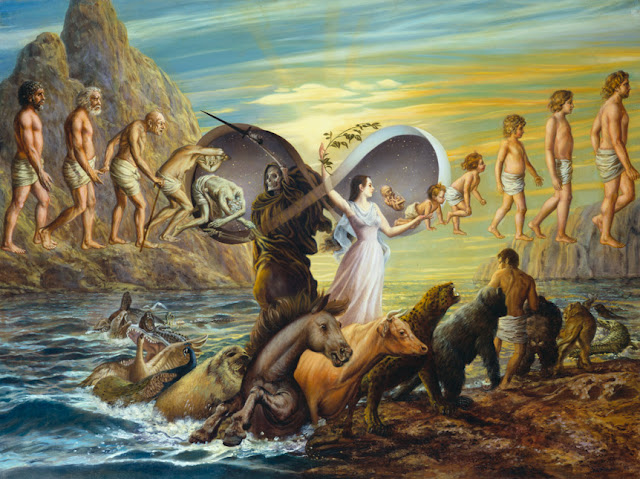
Reincarnation, also called transmigration or metempsychosis, in religion and philosophy, rebirth of the aspect of an individual that persists after bodily death—whether it be consciousness, mind, the soul, or some other entity—in one or more successive existences. Depending upon the tradition, these existences may be human, animal, spiritual, or, in some instances, vegetable. While belief in reincarnation is most characteristic of South Asian and East Asian traditions, it also appears in the religious and philosophical thought of local religions, in some ancient Middle Eastern religions (e.g., the Greek Orphic mystery, or salvation, religion), Manichaeism, and gnosticism, as well as in such modern religious movements as theosophy. In many local religions, belief in multiple souls is common. The soul is frequently viewed as capable of leaving the body through the mouth or the nostrils and of being reborn, for example, as a bird, a butterfly, or an insect. The Venda of southern...

Celebrating Birthdays of the Dead

Image
Hey guys, sorry about all the death posts in the last few days (including this one), but it's just been on the mind recently, you know what I mean? Your birthday is your day. Even if you don't celebrate on the anniversary of your birth, people in your life will honor you on this day with gifts, song and special treatment. And in turn, you honor your loved ones on their birthdays too. But what about those who have passed away? No matter what, the date of your deceased loved one's birth will remind you of them. Past birthdays, parties, gifts and adventures are painful to recall in the aftermath of a special person's death. That's why some people choose to carry on the tradition of honoring the birthdays of a dead friend or relatives, even though the person of honor is missing from the festivities. Relationships Continue Long After Death Just because someone you love no longer walks on earth does not mean your relationship is over. Nor does it mean ...

Welcoming Death

Image
“To the well-organized mind, death is but the next great adventure.”  J.K. Rowling, Harry Potter and the Sorcerer's Stone   "All we have to decide is what to do with the time that is given us.”  J.R.R.Tolkien, The Fellowship of the Ring Instead of trying to deny death perhaps it can be welcomed. There are several cultures, religions and philosophies that treat death as a lesser evil than suffering in life. The author of the Old Testament Book of Ecclesiastes welcomed “a time to die” in a mood of profound pessimism. This also is found in Buddhism: the Buddha’s view was that life is essentially suffering and desire is at the root of this suffering. Only the extinction of desire through strenuous spiritual exercises will stop the endless cycle of deaths and rebirths so that the blessed state of nirvana, or permanent extinction, can be attained. In some cultures it has been respectable to seek death by suicide. During the migrations of a community of Australian...

Living A Good Life Without Purpose

Image
Have you ever felt guilty, restless, disappointed, or lost because you couldn’t define your life purpose? Everywhere I turn, I read or am told I must find my purpose. I have colluded with this dogma and told thousands of people the same thing — you need to find your purpose to be happy. What if you can’t find your purpose? Or maybe you had to give up pursuing what you thought was your purpose to survive. Are you a failure? For decades, children have been raised with the message that they are special and self-help books decry the need for finding your True North. Instead of helping us realize our best self, could this push us to feeling that our lives are never good enough or worse, we are never good enough? Are those of us who haven’t heard our calling doomed to an incessant pursuit of unrealized potential? Can you focus your life without pinpointing a specific purpose or defining a vision of personal success? To start, let me clarify what I mean by “life purpos...

Living a Meaningful Life

Image
Although we might think happiness – or the pursuit of it – will make us feel better about ourselves and our lives, research indicates that it’s actually finding greater meaning in our lives that, at the end of the day – or our lives – is more fulfilling.   In Emily Esfahani Smith’s fascinating article, "There is more to happiness than being happy," she reports, "While happiness is an emotion felt in the here and now, it ultimately fades away, just as all emotions do; positive affect and feelings of pleasure are fleeting. The amount of time people report feeling good or bad correlates with happiness but not at all with meaning. Meaning, on the other hand, is enduring. It connects the past to the present to the future." We wholeheartedly agree, and have devoted our professional careers to helping to make that a reality shared by as many people as possible. The Pursuit of Happiness In the days of yore, our nation’s Founding Fathers included in the Co...

What Does It Feel Like to Die?

Image
So, I have been trying to research what happens when we die for a very long time now. The reason it’s taken so long is because I wanted actual , clinical answers to what happens, but all I could ever find were articles written by people who have “died and come back” and met God and all their relatives before being sent back down to Earth. Not that I have anything wrong with people that experience that (and I fully believe they did see something like that), but I’m looking for hard facts. Not speculation or the faith that someone isn’t lying to me. I'm looking for solid answers, and I know how uncomfortable it may get. After long last I have found an actual article on the factual, real, scary process that is human death. I apologize, first and foremost, to anyone that uncovers any saddening thoughts from this because it will get a little more real than some can handle. Here we go... Death comes for us all here on Earth at a rate of nearly 7,000 people every hour. Yet, ...

Near-Death Experiences & DMT

Image
Near-death experiences are one of the most puzzling phenomena in psychology. A near-death experience is when a person appears to be clinically ‘dead’ for a short period –when their heart stops beating, their brain registers no sign of activity, and the other 'vital signs' indicate death – and yet they report a continuation of consciousness. This may happen following a cardiac arrest, for example. For a few seconds or minutes, a person may show no biological signs of life, and yet when they are resuscitated, report a series of remarkable experiences. NDEs have never been satisfactorily explained in neurobiological terms. Various theories have been suggested, such as hallucinations caused by a lack of oxygen to the brain, undetected brain activity (during the period when the brain appears not to be functioning), the release of endorphins, a psychological ‘depersonalisation’ in response to intense stress, and so on. All of these theories have been found to be problematic...

There is No Life without Death?

Image
What would life be like without death? Would there even be such a thing as ‘life’ without death? And why do we die? What’s the purpose of it? Is there even a purpose of it? Is there some kind of masochistic creator who likes to hurt us? And if so, wouldn’t making people die contradict its notion of creating? Or maybe even the creator became confused about the notions of life and death, and in the end decided just to go with it? Whatever the explanation is, death remains a mysterious, yet inescapable, destination we all share. Let’s see: what causes us to die? Well, death might just come about because of a flaw in our biological make-up; an unintended by-product of the designer of humanity. It might only be due to physical decay that our bodies will – eventually – perish. Death is just another obstacle to overcome in our human struggle with nature, a struggle that we will inevitably come to win. Within a couple of decades from now, people will be able to change their cancerous...