Posts

Showing posts with the label Mythical

Myth Of The Leprechaun

Image
The legend of the Leprechaun is one of the most enduring myths in Ireland and relates to a mystical type of fairy who is originally linked to the Tuatha De Danann of Irish mythology. According to fables, Leprechauns are tiny entities that normally take the form of an old man in a red or green coat. They are known to be mischievous little creatures that like to make shoes and store their gold coins in a pot of gold that is hidden at the end of a rainbow. If you happen to capture a Leprechaun, he will give you three wishes provided you let him go. Leprechaun Origin Most Leprechaun legends can be traced back to the 8th century tales of water spirits which were known as ‘luchorpán’ which means ‘small body’. It is said that these spirits merged with a household fairy and developed a penchant for heavy drinking so no cellar was safe! According to other researchers, the term Leprechaun actually comes from the Irish term ‘leath brogan’ which means shoemaker. It is inter...

The Hundred-Handed Ones of Greek Mythology

Image
Like mortals, the gods could take each other as husband and wife, and would bear children. Sometimes though, a child could be born into the world as a terrible, misshapen form and be seen as a ‘monster’ by others, even their own parents. Such was the case with the Hecatonchires, also named the Hundred-Handed Ones. Mortals can see the helplessness of a newborn baby just by the way that the child cannot yet control its limbs or facial expressions; they see these motions as endearing, and cute even. Something about the baby’s helplessness is a part of what makes us want to care and nurture them. And the gods are no exception to this in life. And like mortals, they too are also able to see a monstrosity when it is born, as was the case with the Hecatonchires. Picture not a normal baby with two flailing arms, but one with 100 quivering, shaking, and unmatched limbs. Added to this were 50 wailing heads with wide-open mouths, producing furious cries that shook Olympus itself. Im...

Space Penguins of Tuscumbia, Missouri

Image
In the winter of 1967, a no-nonsense Missouri farmer had a run-in with a horde or strange, scurrying, entities from outer space that one could only describe as resembling “green space penguins.” On the bone chilling morning of February 14, 1967, a 64-year old farmer by the name of Claude Edwards woke up to attend to his duties on a remote parcel of land near Tuscumbia, Missouri. As the sun rose low on the horizon, Edwards bundled up to face the bitter day, never imagining that he was about to have a face to face encounter with the unknown. Edwards was a simple, hardworking, salt of the Earth Midwesterner who had no time for any kind of foolishness regarding aliens, flying saucers or the like; so as his worn boots tramped across the icy, rock strewn slope that took him from his home to his barn, nothing could have shocked him more than to see what appeared to be a UFO sitting in one of his nearby fields. Edwards stated that before he saw this unusual object, the fi...

Antigone: The Feminist Heroine

Image
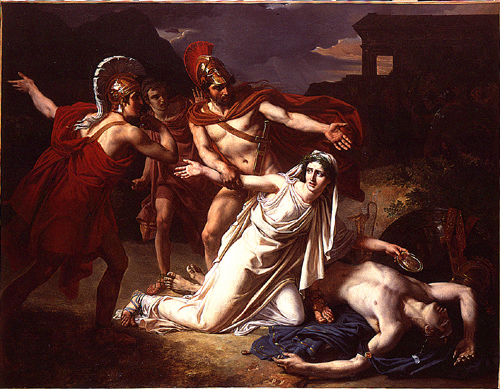
Antigone, a heroine, icon, and role model has survived the test of time for over two thousand years, and with valid reason. Her actions depicted in the play Antigone by Sophocles are those of courage and fearlessness. She also conveys a sense of deep conviction in the pursuit of truth as she stared deep into the eyes of injustice by her oppressor. Valiance is a quality that Antigone has in abundance; she exhibits this with virtually every word she speaks as if she is possessed by the Gods on a righteous journey to lay her brother’s body to rest in an act of defiance against the newly appointed king of Thebes, Creon. It is no surprise that today Antigone is regarded as a role model for women and more specifically feminists. To truly appreciate the character, we must take a closer look into the context of her environment. Patriarchy was alive and strong in ancient Greece and men dominated the political and social spectrum. Their methods of justification stemmed from classical m...

Fenrir - Norse Mythology

Image
Fenrir (pronounced “FEN-rir;” Old Norse Fenrir , “He Who Dwells in the Marshes”) is the most infamous of the many wolves in Norse mythology. His importance for the pre-Christian Scandinavians is demonstrated by his being depicted on numerous surviving runestones, not to mention his ubiquity in Old Norse literary sources. He’s the son of the god Loki and the giantess Angrboda, which makes him the brother of the serpent Jormungand and the underworld goddess Hel. As is recounted more fully in the tale The Binding of Fenrir , the Aesir gods raised Fenrir themselves in order to keep him under their control and prevent him from wreaking havoc throughout the Nine Worlds. He grew at an astonishingly fast pace, however, and eventually the troubled gods decided to chain him up. Their first two attempts were unsuccessful; while the cunning gods convinced Fenrir that it was only a game, a test of his strength, he broke through the fetters easily. For their third attempt, the gods h...

The Myth of the Reaper

Image
Most people have heard of the grim reaper, and if not in those words exactly, they at least know of a hooded skeletal figure that carries around a weapon used to collect souls and transfer them to the after life, what ever your belief tells you that is. Some times he is even depicted as carrying an hourglass, waiting for your time to run out. But where did he come from? When did the term grim reaper begin to be used? And just how far back can you trace him? And what exactly is he? The Grim Reaper, as he is often named, is the personification of death. He is portrayed, usually in western cultures, as a skeletal figure in a long hooded robe tied around the middle and carrying a scythe or a sickle. He uses this tool to collect the souls of the dead and to carry them to their after life. The term "Grim reaper" along with the now near universal image of him came about during the Middle Ages in various paintings and writings of the time. He is also known as one of the...

Cupid: A Mythological History

Image
If you mention 'Cupid' to just about anybody, they'll tell you he is the Greek God of Love. but how much do we really know that is fact rather than fiction? Who is Cupid? In Latin, Cupid goes by two names that have different origins, but whose meanings are both associated with love. One of Cupid’s Roman names is Cupido. This form means ‘desire.’ If we stop to think about it, regardless of our age, the people we love deeply are ones we enjoy and desire to be with as much as possible. Cupid’s other Latin name is ‘Amor’. For students enrolled in Latin I, this is one of the very first verbs (amo) that we learn to conjugate. Two of the major planets in our solar system bear the names of Cupid's mother, Venus, and his father, Mars. Although Cupid is never seen, when the weather conditions are exactly right, both of these planets can be seen in the sky after dark or whenever a planetarium is open to visitors. In Greek Mythology, Cupid was known as 'Eros...

Banshee - Irish Mythology

Image
What is a Banshee? It’s a dark night in Ireland, and the forests are filled with mist. A bloodcurdling wail slices open the silence—and it is followed by more cries. You might think that the anguished cries are coming from a dying person, and in a way, you would be right. These are the cries of the ghostly Banshee, meant as a warning that death approaches. Physical Description Despite their good intentions, Banshees don’t look like the friendliest of creatures! They can appear as withered old hags or supernaturally beautiful women. They wear shadowy grey cloaks or silvery shrouds over red or green dresses. Their hair, which can be red or a pale color that “shimmers like wildfire,” is long and windblown. And their eyes are always inflamed from weeping. The Scottish bean nighe , which are often considered Scottish banshees, can be identified by a few unusual signs: their breasts droop, they have only one nostril, and their feet are webbed like a duck. Personali...

How Did Groundhog Day Get Started?

Image
To the unfamiliar, Groundhog Day is perhaps one of America’s weirdest traditions. Every Feb. 2, people wait for a large, furry rodent to see his shadow and then we predict the weather based on the animal’s actions. But the winter holiday has a long history rooted in everything from early Christian traditions in Europe to 19th century American newspapers. Here is everything you need to know about how Groundhog Day got its start. The Origin Story The idea of Groundhog Day comes from an ancient Christian celebration known as Candlemas Day, which marked the midpoint between the winter solstice and the spring equinox, according to the National Centers for Environmental Information. On Candlemas Day, clergy would bless candles needed for winter and distribute them to the people, the Punxsutawney Groundhog Club’s website says. Superstition held that if the day was sunny and clear, people could expect a long, rough winter, but if the sky was cloudy, warm weather would arri...

Alan Moore: Art is Magic

Image
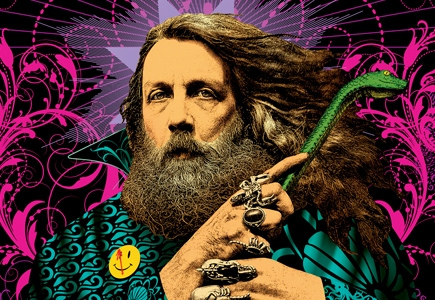
“In order to be able to make it you have to put aside the fear of failing and the desire of succeeding. You have to do these things completely purely without fear, without desire. Because things that we do without lust or result are the purest actions that we shall ever take.” -Alan Moore I have a great appreciation for Alan Moore. It is an inarguable fact that he helped transform the medium of comic books into something quasi-respectable. His run on Swamp Thing alone brought a new consciousness to comics. With the help of the inimitable illustrator J. H. Williams III, he created my all time favorite series Promethea . He is the architect behind Watchmen , V for Vendetta , The League of Extraordinary Gentlemen and From Hell (if you’ve only seen these works adapted as film, you have not experienced the genius of Alan Moore). However, as much as I love Alan Moore the writer, I am most interested in the Alan Moore the magician. Last night I watched The Mindscape of Alan Moore ...

Who is Jack Frost?

Image
It's beginning to look (and feel) a lot like winter finally, so I thought, since today is Mythical day, I'd talk about the guy whose been causing all this freezing weather. You might have heard of him, the one responsible for nipping at your nose and frosting your windows with fern-like patterns during wintertime. His name is Jack Frost, and his legend dates back centuries. So who is Jack Frost? Who is Jack Frost? Jack Frost Origins There’s not one particular story that we can point to for the creation of Jack Frost, but rather a collection of stories taken from countries all over the world. In some cultures he’s considered a villain, in some hero, but in all of them he’s the personification of the winter season. While there’s much debate over the origins of Jack Frost, many believe he originated from Scandinavian or Anglo-Saxon traditions. In one popular story, he’s the son of Kari, Norse god of the winds. In Finnish folklore, there is the legend of Frostman ...

MOMO: The Missouri Bigfoot

Image
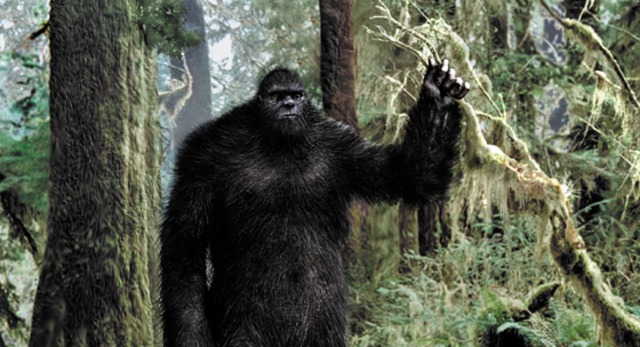
thepitchkc.com During the summer of 1972, newspapers all across the country picked up the story of “Momo”. Momo is a short abbreviation of Missouri. MO is the abbreviation, and when you say this shortened name twice, you get the word Momo. This United States monster story happened in a small town that is located in northeast Missouri. During July of 1971 is when the first reported encounter happened with Momo, the Missouri monster. It all started when there were two people out for a picnic when they witnessed a “half ape half man” creature. The creature reportedly had an awful smell to it. The couple said the monster walked out of an area of thicket, and then started to come towards them. They ran into their car and locked the doors. The couple say the creature ate the peanut butter sandwich they left when they ran into the car. After eating the sandwich, the creature went back into the wooded area. The two women, who were the two at the picnic, reported this encoun...